
The Question

In ‘At Sea’ how does the poet present ideas about loss? [24 marks]
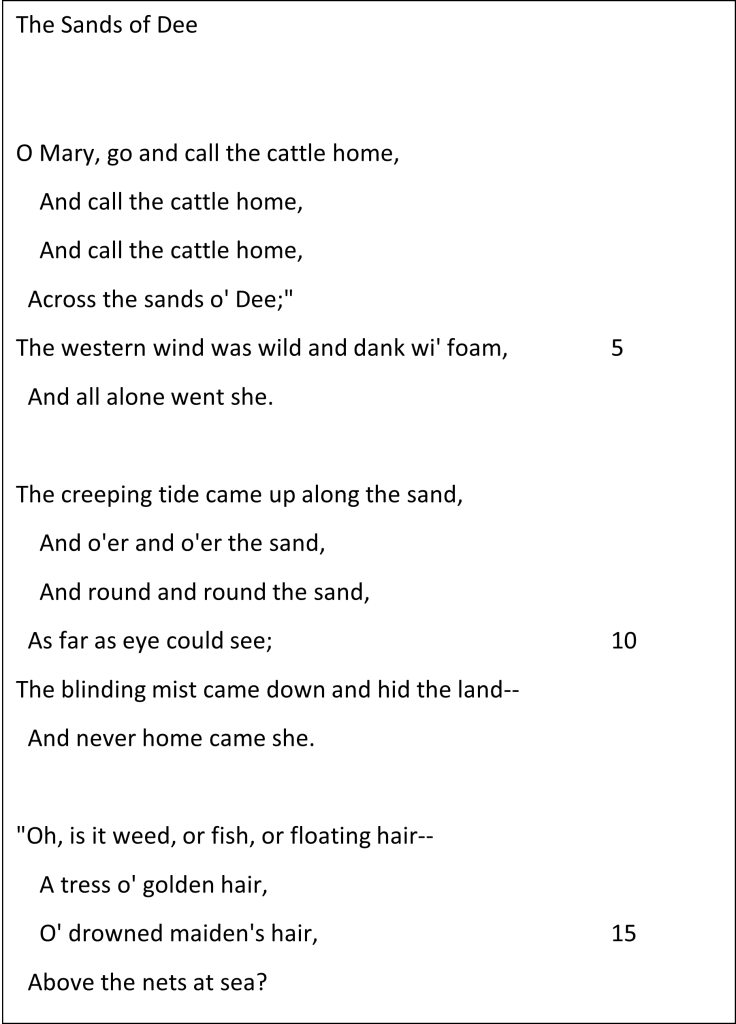
In both ‘At Sea and ‘The Sands of Dee’ the speakers describe ideas about the power of the sea. What are the similarities and/or differences between the ways the poets present these ideas? [8 marks]
The Response
Thematically speaking, Copley presents the loss of a loved one as something that causes deep emotional pain. When considering this, one immediately notices the title of the poem itself. The image of someone being ‘at sea’ typically describes the action of being lost or aimless, perhaps indicating that the speaker no longer feels in control of her life. The loss of her loved one has created a void in her life, reducing her to someone who is ‘at sea’. One also perhaps imagines the speaker cast adrift in an ocean, small and alone and without any direction or support. This helps to establish the pain the speaker feels, but also her emotional fragility. This tone of fragility is further suggested through Copley’s use of the adjective ‘bleached’ to describe the veranda. When one imagines something that is bleached one perhaps thinks of an object without life, almost sickly and drained of energy. This perhaps further helps to capture and mimic the speaker’s emotional state due to the loss of a loved one. Not only is she ‘at sea’, but any joy and happiness she once felt, one could argue, has been drained away, leaving her, perhaps literally and metaphorically, weak and exhausted. However, the fact she is ‘sweeping’ the veranda ‘clear of sand’ perhaps indicates some small hope, almost a sense she is hoping to begin again as well as a willingness, even in the face of the pain caused by loss, to maintain some order and cohesion. Of course, this action could also indicate a lack of purpose, perhaps she no longer has anything with which to occupy her time. This is perhaps augmented by the use of free verse throughout the poem, again helping to cement a lack of control and a chaos that has entered her life because of the loss of a loved one.
The emotional turmoil thus far established is then continued into the second stanza when Copley describes the ocean as ‘loathed’. This highly aggressive word, far more violent than hated or disliked, helps to capture the speaker’s deep pain: it is almost as if she needs an external object onto which to project her inner agony. Her loss has caused so much pain, one could argue, that it almost spills out of the speaker, attaching itself to whatever happens to be closest. One could press upon this further and consider the typical connotations of the ocean, as something that is possibly tranquil and peaceful, but here, because of her loss, her life has been stripped of any such happiness, with the ocean reduced to a figure of hatred. One could also perhaps wonder as to why she targets the ocean specifically, perhaps speculating that this is a place that holds happy memories for the speaker and lover, memories that have now soured. The fact she dreams of the ocean ‘coming for her’ and ‘creeping through the door’ perhaps symbolises the way in which her emotions engulf her, with the present participle ‘creeping’ creating a foreboding tone as well as an action that is ongoing instead of in the past. There is a sense she cannot escape her pain and what she has lost, with the sea representing some inescapable and sinister force.
The pain the speaker feels is further compounded by Copley’s disquieting image of the ‘screaming gulls’. Again, one imagines that this highlights the way in which the speaker has externalised her internal pain, given that one would not typically associate the noise a gull makes as screaming, with cawing or crying usually more apt. The use of ‘scream’ in itself is highly significant, since it describes a raw and prolonged expression of pain, usually physical. This helps precisely to capture just how much pain the speaker is going through: her life seems devoid of any serenity or inner peace, with a gull’s typically calm noises transformed to ‘screaming’ because of the pain she feels. It is also noteworthy that she ‘wakes’ to this screaming, suggesting that this is now her reality and something she cannot escape.
Fundamentally, Copley grapples with the searing pain that loss can bring and whilst it is not clear what the reason for this loss is, in many ways this does not matter, with this ambiguity only serving to refocus attention on the speaker’s emotional reaction. The loss of her loved one has left her alone and aimless, adrift in a world now filled with pain.
Both Copley and Kingsley make effective use of language when considering the ways in which they depict the power of the sea. Both poems personify the sea by describing it as ‘creeping’ and this helps to suggest that the sea is a sinister and menacing force. When one imagines someone ‘creeping’ one imagines someone doing something they should not, perhaps hoping to cause harm. This helps to convey both the power but also danger of the sea, a tone evident in both poems. Both poems also utilise typically violent and aggressive words to describe the power of the sea, with Kingsley using a cluster of violent words such as ‘blinding’, ‘cruel’ and ‘hungry’. Here, the sea is again personified to indicate it is a relentless force that seeks to do harm, especially the use of ‘cruel’ which indicates a deliberate action intended to cause pain. Similarly, Copley describes the ‘ocean’ as ‘loathed’, with this helping, as with Kingsley, to depict the sea as an enemy.
Both Copley and Kingsley also make effective use of form and structure to depict the power of the sea. Copley utilises free verse throughout her poem which helps to establish the sea as a chaotic force as well as suggesting how aimless the speaker’s life has become. In contrast, Kingsley uses a regular rhyme scheme, perhaps suggesting, rather than chaos, the rhythmic and controlling nature of the sea. It is also interesting that Kingsley ends his lines with many of the same words, perhaps suggesting the cyclical and repetitive power of the sea.
 codexterous