If you enjoy this blog post, then you'll love my new book Experiencing English Literature. With dedicated chapters on teaching novels, plays and poetry as well as teaching generative writing, sentence-stems and essay structure, it is filled with actionable strategies ready for the classroom. You can order it right now HERE ! GCSE English Language... Continue Reading →
Literary Puzzles: Using the Do Now in English
With the exception of A Level, the vast majority of my lessons begin in much the same way: 1. Students come into the classroom2. They find waiting for them a task that will take about 5 minutes to complete3. They complete the task4. We talk about it This is such an embedded routine in my... Continue Reading →
Defining Excellence: How I Use Whole Class Feedback
I first encountered whole class feedback several years ago and was instantly captivated. And what's not to love? It promises a significant reduction in workload, no longer spending countless hours huddled over a slow burning lamp with pen in hand (forgive the Dickensian rhetorical flourish) whilst simultaneously, even miraculously, improving student outcome. I remember the... Continue Reading →
Teaching Poetry: A Step by Step Guide
Ok: first of all an admission. The title of this post, with its impossibly bold claim to distil teaching poetry into a series of neatly packaged steps, is somewhat overzealous. In a manner somewhat, and unfavourably, all too familiar to the last year, I fear it will overpromise and underdeliver. However, what it will do,... Continue Reading →
Tell Me Your Favourite Word…: Generative Retrieval for English
There is sometimes, I feel, an assumption that retrieval practice in the English classroom begins and ends with quotation gap fills or basic factual recall. Those making this assumption are often the same people suggesting retrieval practice doesn't work for English. It does, of course. And it's crucial to remind ourselves that you can't think... Continue Reading →
But, what does the text do?
If you enjoy this blog post, then you'll love my new book Experiencing English Literature. With dedicated chapters on teaching novels, plays and poetry as well as teaching generative writing, sentence-stems and essay structure, it is filled with actionable strategies ready for the classroom. You can order it right now HERE ! Yesterday, I posted... Continue Reading →
From Start to Finish: A Detailed Analysis of An Inspector Calls
If you enjoy this blog post, then you'll love my new book Experiencing English Literature. With dedicated chapters on teaching novels, plays and poetry as well as teaching generative writing, sentence-stems and essay structure, it is filled with actionable strategies ready for the classroom. You can order it right now HERE ! Previously posted in... Continue Reading →
Perfecting the Sentence: Explicitly Teaching Sentence Stems
I spend a lot of time at GCSE and A Level explicitly teaching and modelling various types of sentences that I want students to use in essays. These provide a very powerful way in which students can frame and signpost their analysis; a syntactic anchor to hold down their argument. In this post, I want... Continue Reading →
How I Teach the GCSE Poetry Anthology
I really dislike the given AQA Poetry Anthology, not the poems, but the actual physical anthology. My students do too. In fact, I dislike it so much that I set about creating an alternative, that, whilst of course biased, I feel is far superior. This post is about what is included in this alternative and... Continue Reading →
Experiencing English Literature: My First Book (!)
I first started blogging a few ways ago as a way of thinking about and sharing ideas surrounding English teaching. Like I suspect most blogs, it was mostly something for me: a purely personal source of pedagogic introspection and reflection. When I started, I didn't imagine it would become popular and even further from my... Continue Reading →
Why Even Poetry? Why We Teach and Study Poetry
If you enjoy this blog post, then you'll love my new book Experiencing English Literature. With dedicated chapters on teaching novels, plays and poetry as well as teaching generative writing, sentence-stems and essay structure, it is filled with actionable strategies ready for the classroom. You can order it right now HERE ! It’s Friday. 2:55.... Continue Reading →
On Modelling Interpretative Vulnerability
If you enjoy this blog post, then you'll love my new book Experiencing English Literature. With dedicated chapters on teaching novels, plays and poetry as well as teaching generative writing, sentence-stems and essay structure, it is filled with actionable strategies ready for the classroom. You can order it right now HERE ! The disciplinary disposition... Continue Reading →
Live Modelling: Maximising Student Thinking
If you enjoy this blog post, then you'll love my new book Experiencing English Literature. With dedicated chapters on teaching novels, plays and poetry as well as teaching generative writing, sentence-stems and essay structure, it is filled with actionable strategies ready for the classroom. You can order it right now HERE ! Live modelling is... Continue Reading →
The Essay: How To Help Students Get Better at Writing Essays
A couple of days ago I came across this incredibly interesting observation by Peter Stockwell, which immediately got me thinking about lots of things related to essay writing: If there is a canon of literary texts that move in and out of preference over time there is also a canon of acceptable critical discussion that... Continue Reading →
Revising Macbeth: Oxford School Shakespeare GCSE Revision Cards
For very good reason the last several years has witnessed an explosion in thinking about effective revision strategies, with an increasing focus on self-testing and retrieval. As we increasingly use and model these skills in our own classrooms so too do students increasingly use them in their own independent practice. Yet, whilst we may be... Continue Reading →
Readymade Scaffolding: Using the Oxford School Shakespeare Revision Workbooks
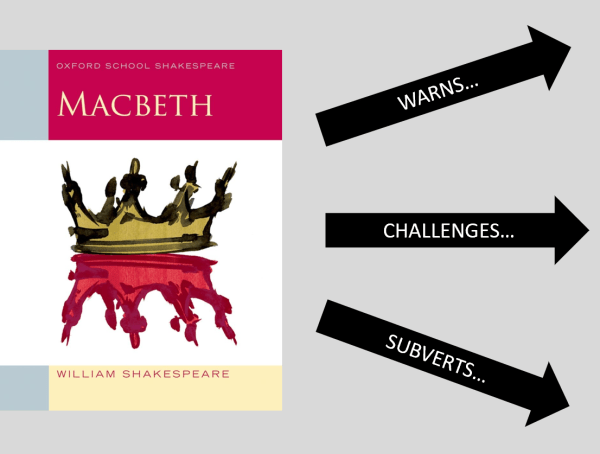
Recently, I’ve been playing around with and using a lot of OUP (Oxford University Press) Shakespeare materials and resources, which are proving to be excellent. In particular, I’ve been experimenting with their ‘Macbeth GCSE Revision Workbook’ by Graham Elsdon, which is part of the Oxford School Shakespeare series. I’ve been using this in the more... Continue Reading →
Using OUP’s English Language Revision Cards
A perennial issue for English teachers is how best to prepare students for English Language. This is for good reason. Without a specific body of knowledge to teach, such as a literary text, it can all too easily descend into vague discussions orbiting around examination papers. In my own teaching, in order to address this,... Continue Reading →
I am a Little World Made Cunningly: The World of the Text
Recently, I have been reading a lot about Text World Theory (and specifically the work of Ian Cushing and Marcello Giovanelli) as I think this has massive potential for how we frame a lot of English teaching and literary pedagogy. However, I’m still working my way through its implications and experimenting with how to use... Continue Reading →
Resonant Reading: A Poetry Reading Strategy
If you enjoy this blog post, then you'll love my new book Experiencing English Literature. With dedicated chapters on teaching novels, plays and poetry as well as teaching generative writing, sentence-stems and essay structure, it is filled with actionable strategies ready for the classroom. You can order it right now HERE ! Before outlining this... Continue Reading →