The poem begins with the weather mimicking the emotion of the couple: ‘The clouds had given their all –’. At a literal level, this image is referencing how the clouds have expended all of their rain. However, at a more symbolic level it reflects how the couple are emotionally exhausted and how the relationship is... Continue Reading →
Teaching Compare and Contrast via Passing References
Most, if not all, English Literature specifications at GCSE and A Level require the student to make points of connection between two texts, something either explicitly stated in the specification or implied through the format of the question. Given its prevalence, making apt and stylistically fluid textual comparisons is an aspect of essay writing that... Continue Reading →
Analysing the News in The Handmaid’s Tale
There are certain moments in a text that could easily be passed by without much thought or attention, but when dwelled over reveal themselves to be surprisingly, teasingly, significant. There is just such a moment in Atwood's The Handmaid's Tale, copied below and taken from Chapter 14: First, though, a little context: this takes place... Continue Reading →
Not Just MCQs and Knowledge Quizzes: Generating Learning with Microsoft Forms
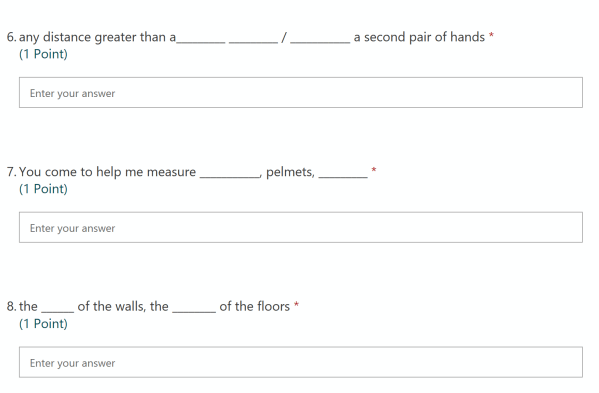
Back in February of last year, I started to play around with using Microsoft Forms, mostly for knowledge quizzes and basic recap of material covered in lessons. I had used it for a few homeworks and was quite happy with the results. It allowed me to identify at a glance any major misconceptions across the... Continue Reading →
Perfecting the Sentence: Explicitly Teaching Sentence Stems
I spend a lot of time at GCSE and A Level explicitly teaching and modelling various types of sentences that I want students to use in essays. These provide a very powerful way in which students can frame and signpost their analysis; a syntactic anchor to hold down their argument. In this post, I want... Continue Reading →
An Analysis: When We Two Parted by Lord Byron
Context & Plot Byron's fellow Romantic poet William Wordsworth once remarked that poetry was the ‘spontaneous overflow of powerful feelings’ and one notices that in this poem the speaker is certainly coming to terms with ‘powerful feelings’.Byron was known to be an especially licentious and promiscuous individual and thus it is no surprise to find... Continue Reading →
An Analysis: Neutral Tones by Thomas Hardy
Context, Plot and Connections Despite being best known as a novelist, Hardy also had a fruitful poetic career. This particular poem is very typical of his general style as evident in other works: it is bleak, melancholy and pessimistic.What is the poem about? The speaker recalls a memory of when he and his lover stood... Continue Reading →
How I Teach the GCSE Poetry Anthology
I really dislike the given AQA Poetry Anthology, not the poems, but the actual physical anthology. My students do too. In fact, I dislike it so much that I set about creating an alternative, that, whilst of course biased, I feel is far superior. This post is about what is included in this alternative and... Continue Reading →
The Colour of Literature: Teaching Literature with Art
Networks of Creativity within Literary Studies One consequence of the increasing disciplinary specialisation of knowledge is that it can sometimes become all too easy to draw boxes around what we teach. In the case of English Literature, we can often overlook the wider artistic and creative networks that surrounded and influenced the writers we discuss.... Continue Reading →
What other words could have been used…?
One of the simplest but most effective questions I ask my students when analysing a text is 'what other words could have been used?' This one question has become a staple of our classroom talk and is now deeply embedded into our discussion and analysis routines. I regularly ask it of them, but much more... Continue Reading →